Pixelverse PixelTap has evolved into a Telegram arcade with event-based prizes
Updated -
Pixelverse PixelTap now appears in Telegram as Arcade by Pixelverse, combining games with competitive events and prize pools. Winning depends on the event's selection rules, and BOING's prize event required a wallet linked inside the app. A round of ordinary play doesn't automatically earn a crypto prize.
The older bot-collection game rewarded in-game progression, while the Arcade format emphasizes several games and scheduled competitions. In-game coins support progression. PIXFI is the ecosystem token, and its original staking program offered lootboxes containing game assets.
In short: Qualifying for BOING's prize draw and receiving an award were separate outcomes, with payment limited to linked Arcade wallets.
Arcade connects the game library with separate prize events
Telegram provides the entry point, while each game's mechanics determine what a competitive score or win measures. MemeBattle centers on squad battles, and the jumping games test timing. Event rules then connect those performances to particular awards. The broader Pixelverse ecosystem also includes a cyberpunk browser-game project, which has its own access arrangements.
Game choice changes the skill and reward conditions
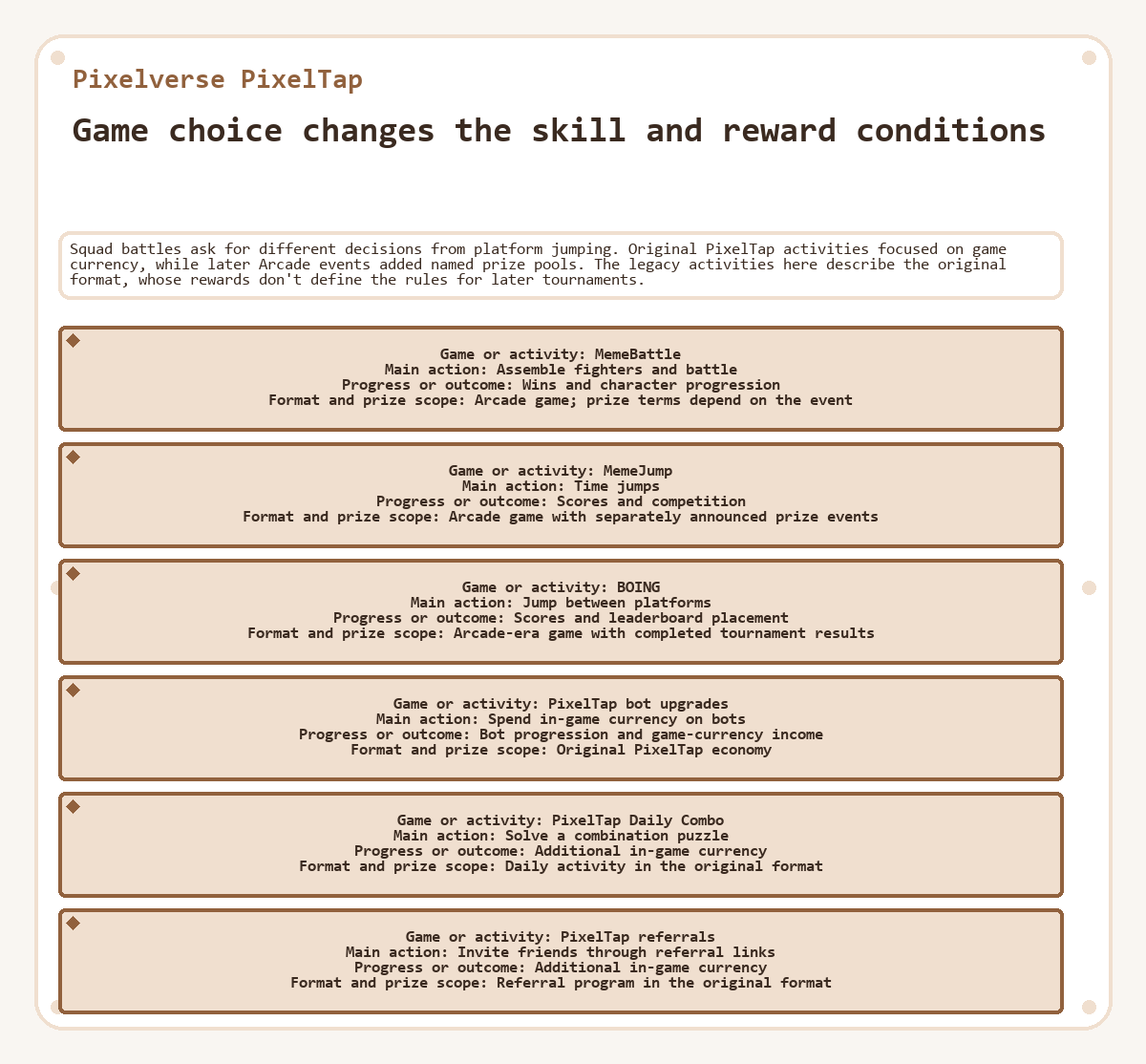
Squad battles ask for different decisions from platform jumping. Original PixelTap activities focused on game currency, while later Arcade events added named prize pools. The legacy activities here describe the original format, whose rewards don't define the rules for later tournaments.
| Game or activity | Main action | Progress or outcome | Format and prize scope |
|---|---|---|---|
| MemeBattle | Assemble fighters and battle | Wins and character progression | Arcade game; prize terms depend on the event |
| MemeJump | Time jumps | Scores and competition | Arcade game with separately announced prize events |
| BOING | Jump between platforms | Scores and leaderboard placement | Arcade-era game with completed tournament results |
| PixelTap bot upgrades | Spend in-game currency on bots | Bot progression and game-currency income | Original PixelTap economy |
| PixelTap Daily Combo | Solve a combination puzzle | Additional in-game currency | Daily activity in the original format |
| PixelTap referrals | Invite friends through referral links | Additional in-game currency | Referral program in the original format |
BOING prize categories used rank and a random draw
$2 000 covered the announced BOING tournament pool, with $100 awards for the top 10 and another 10 random selections. The random selections came from the top 100 on that event's leaderboard. Those award amounts applied only to that completed tournament.
Top 100 described the draw's qualifying group, not the number of people who could play BOING. A position within that group created a chance in the random selection. It didn't award every qualifying account $100. The high-score category separately rewarded placement among the top 10.
MemeJump also combined high-score awards with random selection. Its completed tournament results named the top 10 scorers and 10 randomly chosen players from the top 110. That result described the finished event, so its qualifying group shouldn't replace the terms of another competition.
The BOING results declared winners and described rewards as coming. A winner announcement alone didn't show that an individual wallet had received tokens.
Those completed events no longer offer entry to a new participant. A fresh leaderboard attempt needs an open competition with its own award categories. An announced future pool also needs an entry window before it becomes a contest that players can enter.
BOING prize delivery required a wallet linked inside Arcade
The BOING prize notice required recipients to link their payout wallets inside their Pixelverse Arcade accounts. The relevant link was inside the Telegram app. A wallet connected only to the separate Pixelverse dashboard didn't meet that app-specific instruction. Linking a wallet didn't make every account a winner: selection still followed the tournament's prize categories.
In-game currency and PIXFI serve different purposes
The original PixelTap economy used in-game currency to acquire and improve bots. Those bots could generate more game currency. Gems also served as a task-based currency in a later PixelTap phase. A growing game balance could therefore record progress without representing the amount of PIXFI that a tournament owed its holder.
PIXFI is the ecosystem token, while a game score measures performance. An event's terms identify any token or other prize attached to that performance. Character names don't settle the asset choice, and a score alone supplies no conversion rate into PIXFI.
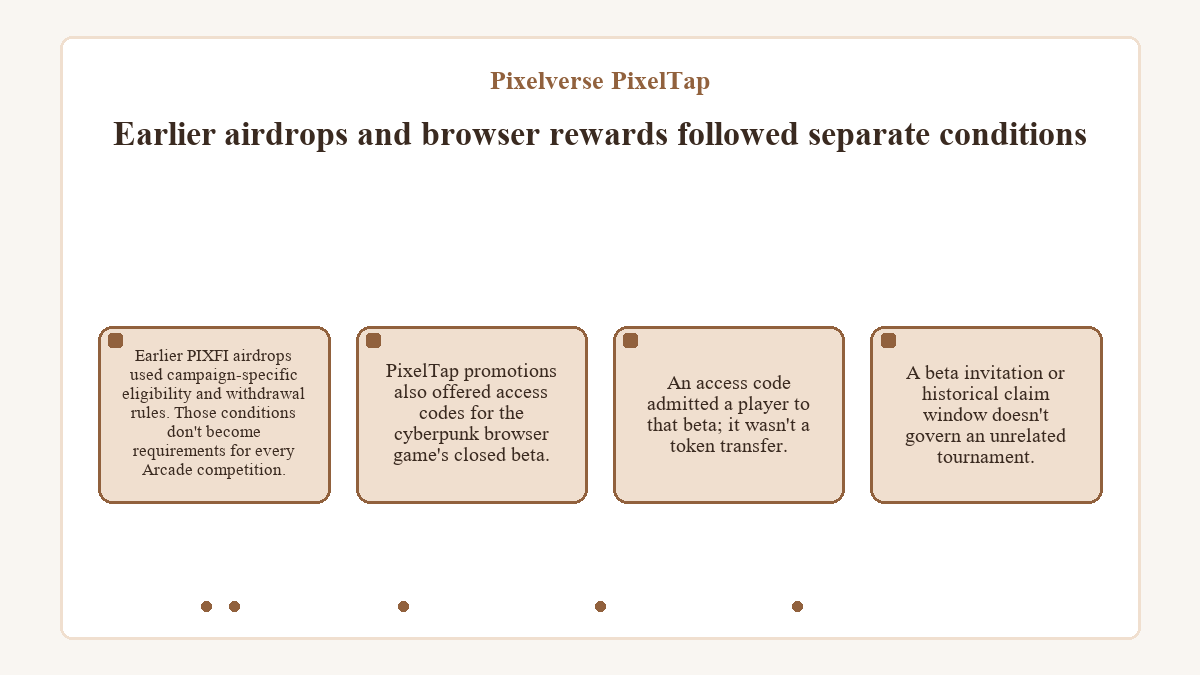
Earlier airdrops and browser rewards followed separate conditions
Earlier PIXFI airdrops used campaign-specific eligibility and withdrawal rules. Those conditions don't become requirements for every Arcade competition. PixelTap promotions also offered access codes for the cyberpunk browser game's closed beta. An access code admitted a player to that beta; it wasn't a token transfer. A beta invitation or historical claim window doesn't govern an unrelated tournament.
Free entry and payout terms shape the time commitment
The advertised MemeJump giveaway allowed free play, making an entry fee unnecessary for that particular event. That fact doesn't set a fee schedule for all Arcade prizes. A useful prize offer identifies the reward asset, award size and any charges that apply to delivery. Where a transfer charge applies, it affects the amount left after payment; a dollar headline alone doesn't establish a fixed net PIXFI amount.
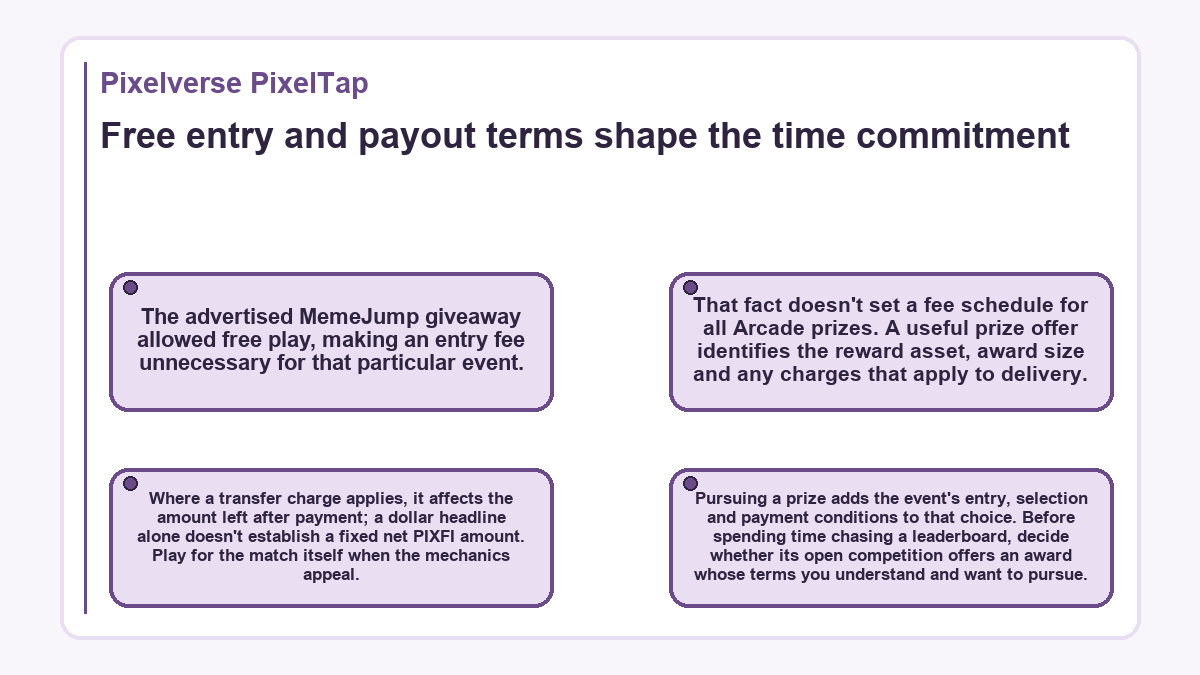
Play for the match itself when the mechanics appeal. Pursuing a prize adds the event's entry, selection and payment conditions to that choice. Before spending time chasing a leaderboard, decide whether its open competition offers an award whose terms you understand and want to pursue.
Popular questions about Pixelverse PixelTap
How many fighters make up a MemeBattle squad?
A MemeBattle squad contains five characters. Its public-opening description grouped fighters into strikers, supports and healers, with abilities that affect team selection. Choosing a squad involves both the number of fighters and how their roles work together; a character's memecoin name doesn't describe its combat function.
Where should I land in BOING to score more points?
BOING gives more points for landing in the center of a platform. Its described platforms can remain solid, move or disappear. Landing accuracy therefore matters to a leaderboard attempt, while falling off ends the round.
Were the older PixelTap wheel's prizes all cryptocurrency?
The older PixelTap wheel offered both crypto and non-crypto prizes. Its advertised possibilities included TON, in-game currencies and access to the browser game's closed beta. A beta code provided admission to that game, while game currency supported progression; neither represented the same reward as receiving a named cryptocurrency.
Does winning a MemeJump friend challenge earn the tournament prize?
MemeJump's friend challenge uses the two players' scores to decide the result. Prize tournaments have their own award categories and eligible ranked groups. Winning a friend challenge therefore isn't enough information to determine a tournament award; the relevant event must also include that play under its prize rules.
Are Arcade prize tournaments open every week?
Pixelverse advertises weekly tournaments, but entry depends on a specific event's announced window. A weekly promotion doesn't mean each game continuously accepts prize entries. The completed BOING and MemeJump competitions were individual events with results, so their old prize pools aren't ongoing weekly offers.